 It’s not uncommon to find large and small companies either using multiple separate systems or using Excel Spreadsheets and emails to run the business. Most likely, what you’ll find at these companies are employees relying heavily on their emails to track and manage important files and information, miscommunication between departments, inaccurate and outdated data being shared, and more inefficiencies.
As per our previous blog on the “Dangers of Running a Business solely on Microsoft Office tools”, companies are likely to experience the following if they rely heavily on Excel spreadsheets and other Microsoft Office tools;
- Data loss and corruption; Spreadsheets are known to become unstable the more information is added to them.
- Typos and other errors; Sometimes, small typo errors can be difficult to catch but in the long run can cause major problems and headaches.
- In most cases, these spreadsheets are being shared between various departments. What can happen is that various versions of the same file can be passed around and saved by each department. At this time, different information is travelling from person to person, which can also cause serious problems in the future.
We do realize, however, that change is not always easy for employees and for management in any company and implementing new processes or procedures and implementing new systems is difficult and time consuming. However, change is also inevitable. The business world is constantly evolving and companies should always be ready to adapt in a moment’s notice. So, before getting overwhelmed by the costs involved or the time and effort involved in this finding solutions to current inefficiencies at your business and implementing those solutions, think about the benefits and cost and time savings in the future.
What are your next steps?
Once management understands or realizes their main challenges and problems, it’s now time to gather all your key employees, from each department and write down their processes and day-to-day tasks. This not only allows management to fully understand what their teams are doing and how they are doing it, but also to help properly document important processes.
Next, it’s a great idea to share this documentation with the whole management team, business consultants, IT consultants and top department heads and determine if teams are working with the best and most efficient processes. If not, now is the time to go through each process and find solutions to challenges and better ways of doing things. In many cases, simply by implementing one system for all departments, like a complete ERP solution, with specific rights and permissions can solve a whole lot of headaches and improve efficiency right from the get-go.
In this case, with ONE software system, using ONE database, all employees will have access to important, accurate information. No need to go through hundreds of emails per day or find the latest Excel spreadsheets to find information related to products, sales, etc. This saves a lot of time, effort and critical mistakes!
So, if you are looking to increase data accessibility and visibility, reduce errors, increase efficiency and improve communication company-wide, contact our consultants today!
 For many business owners or managers, making the decision to implement a new software system is a difficult one to make. Oftentimes, the changes and risks that come with a software implementation can discourage those business managers who are looking to streamline their company’s processes and improve overall efficiency with a new system. There’s a ton of information out there on the advantages of using an efficient, up-to-date ERP system but not that much on how to properly handle an implementation phase. No Software Provider wants to scare their clients right from the get-go but this is definitely the wrong approach. By not educating the new software users and providing all the necessary information right from the start, all parties will suffer during the implementation phase.
Therefore, to begin with, it’s important to know the possible risks involved in such a project. This can include failure, user resistance, employee stress and anxiety, improper use of the system, misunderstandings, problems, doubts, fear of change etc. In order to ensure that these risks are eliminated or reduced, end user training is definitely required. These trainings will provide employees (or end users) with the right amount of attention and skills needed to help them acclimate to new processes (that have been changed by the new system implementation) as well as to the new system itself.
You can begin by creating a training plan then scheduling it accordingly, by department or simply by department heads and managers. Trainings can be given either in small groups or on a one-on-one basis. Documentation of course will also be provided to ensure that employees can easily access a “how-to” guide on using the system.
Once these trainings are underway, its advantages will be quite evident since trainings can alleviate stress, combat fears, bring acceptance to the system, reduce system errors and misunderstandings. Bottom line, when software users are properly educated on new functionality and processes, it’s a WIN-WIN for everyone! The trainings will teach end users the necessary skills needed to prevent problems and to use the system in the most efficient way possible. Individual performance will improve thus increasing productivity. Business managers will be happy as well as Software Providers.
As a Software Provider, our team truly understands just how important it is to pay attention to the USERS (or employees) and their needs during an implementation phase, rather than on solely the system itself. We realize how difficult this time may be for some people, especially if they have been used to working with the same processes and systems for years and have developed habits and routines in their workplace. Introducing a new software management system, with new processes, can disrupt their work life and this most definitely can cause stress and fear.
As a complete ERP software implementation can typically take about 12 months, it’s important that during this time, everyone is working together, as a team, for a successful and smooth phase. No surprises or headaches!
JD Edwards, or JDE, is an Enterprise Resource Planning (ERP) system by Oracle. There are currently two editions, JDE Enterprise One or JD Edwards World. In many ways, this ERP solution is great for corporate-level enterprises, as it offers many tools and connectors for data integration. One key challenge, however, that companies using a JDE system, no matter its edition, are faced with is the lack of ease for EDI integration within the system. Currently, there is no out-of-the-box integrated EDI solution or connector that would make this process easy, quick and seamless.
Our team has encountered many companies struggling with this inefficiency. As we are not JDE experts, but instead EDI integration experts, we’ve teamed up with our partners at Magic Software Enterprises, who have worked in the JDE world for many years. By leveraging our combined expertise, teamwork and solutions (which will be mentioned below), JDE users can have an EDI integration project that is efficient, successful and within budget.
Therefore, how do we help companies overcome common EDI challenges with their JD Edwards system? By using our popular EDI2XML services, along with Magic Software’s powerful business integration platform called Magic xpi & certified JDE adaptor.
EDI2XML
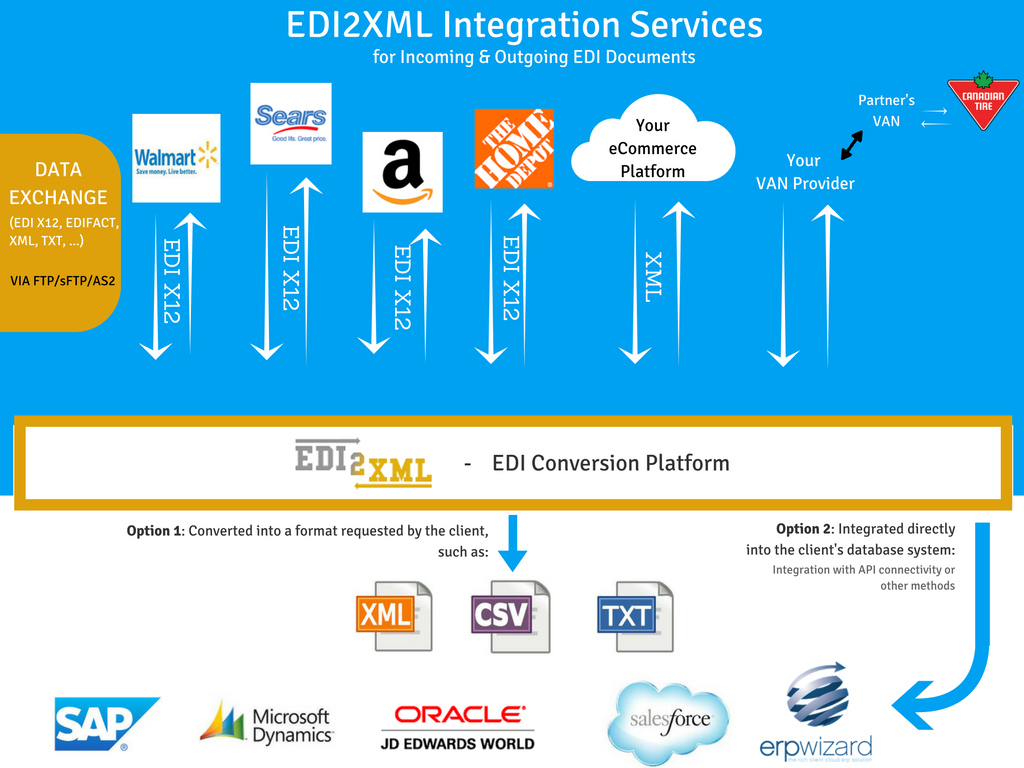
Our team of EDI experts handle the entire EDI portion of the project, where we convert all EDI X12 or EDIFACT documents into the desired format that is requested by the client, such as flat file, XML, CSV, etc. For outgoing files, EDI2XML works by converting the XML / CSV file into the EDI format, requested by the Trading Partner. We take care of all EDI mapping, Trading Partner configuration, XML/CSV/flat file translations, and back and forth transactions with Trading Partners. Visit us at http://www.edi2xml.com
Read: The Definitive Checklist For Oracle JDE and EDI Integration Projects
Magic xpi for JDE
Magic Software’s xpi platform is an ‘Oracle Validated Integration’ solution that can be used to orchestrate the entire business process, no matter if you are using JD Edwards Enterprise One or JD Edwards World. It comes with a ton of built-in components to build workflows and streamline an entire business flow;
- Database Gateways to connect with common databases, such as SQL Server, Oracle, DB2, Pervasive, MySQL, ODBC, etc.
- Connectors that allow users to directly connect to JDE, SAP, Dynamics, Salesforce, etc.
- Triggers & Data Mappers to monitor folders and to map from one file format to another.
- Connectivity & Messaging through FTP, SOAP, MSMQ, etc.
Therefore, if an incoming EDI document is received by a company, our EDI2XML service will convert this file into the client’s desired format (let’s say XML), then using Magic xpi, will be mapped to JDE by;
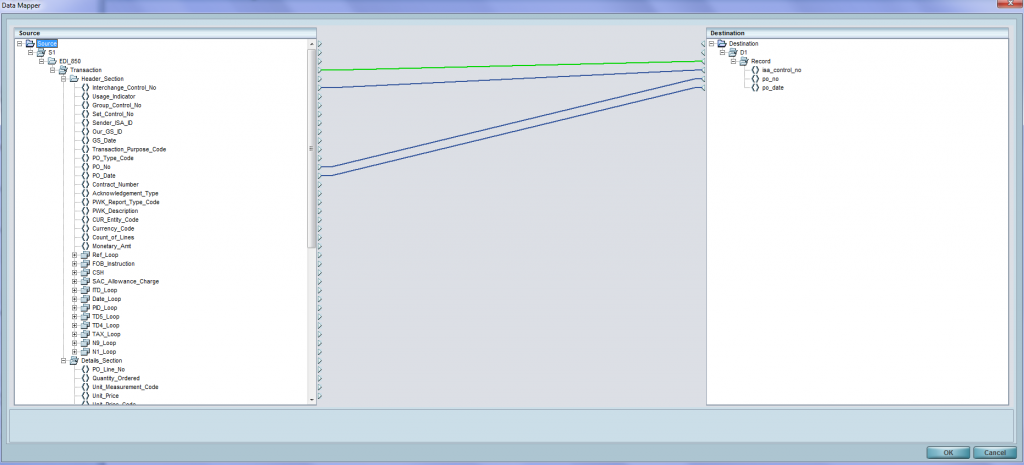
- Creating a step with a Data Mapper
- Source: XML based on the EDI2XML .xsd (schema file)
- Destination: the JDE table to feed from the XML format
Once the source and destination are defined, the user can use his or her mouse to drag and drop to map fields from the source to the destination (JDE table).
In this day and age, EDI integration within management systems should be seamless but for many it is not. This is can cause major headaches for managers. Companies no longer want to hire in-house EDI experts when they already have a full team of in-house JDE developers. It’s about time JDE users can rely on an outsourced EDI Integration Partner that will ensure their daily EDI transactions are processed and streamlined, without difficulties.
Call us today +1 450-681-3009 to learn more about our EDI2XML Service and JDE Integration capabilities with our Magic Software partner.
What is System Integration?
 System integration is the process of bringing multiple systems or applications into one, allowing them to work together. The goal is so that every system that is being used at the company, be it your CRM, Enterprise Resource Planning (ERP), Warehouse Management, B2C eStore, EDI, etc., will be using a single database. This reduces the need to constantly update different systems and resort to many hours of manual data entry. In today’s fast-paced business environment, it’s crucial that companies have management applications that can speak with one another and share information between them. This results in better visibility and accessibility of information, faster decision-making, reduced redundancies, increased efficiency and more.
Most of the time however we don’t just leave it at “system” integration but expand it to be “business process” integration. We encourage businesses to not only synchronize their internal applications but to streamline entire processes between their departments or business functions as well as connect to their external partners, suppliers and customers.
Integration Services
It’s no wonder that Integration Services have been on the rise over the last few years. As we see more importance being placed on technology in the workplace, business managers are taking notice of the negative impact associated to the use of multiple disconnected management systems. Today businesses are looking to have one clean data set and a complete ERP management system with an integrated eCommerce Store, WMS system, EDI module, Business Intelligence dashboards and more. The effects of such a powerful integrated management solution can bring endless potential to a company and allow employees to constantly have access to real-time business information. Tech-savvy business owners are quickly realizing how to apply technological advancements in order to play them to their advantage.
System and business process integration
System and business process integration has been valuable in eliminating redundancies and making information that much more accessible to decision-makers. Nobody likes to waste time and money on inputting data into multiple systems or continuously updating and searching for information in Excel spreadsheets. On top of it all, with disconnected systems or several separate databases, companies sometimes struggle with poor customer service. More often than not, customer accounts are found to be incomplete, out of sync and/or inaccurate. By integrating systems and processes, your customer service team will have accurate, complete, real-time information right at their fingertips. As I mentioned before, it’s all about providing employees and key decision-makers with access to information.
Unfortunately, not all systems were made to be easily integrated with others (this is a capability our consultants urge business owners to tick off when looking to implement a new ERP solution). The older, inflexible legacy systems were made with limitations to integration possibilities. IT companies, back then, did their best to keep their customers coming back to buy their products rather than make it easy for them to switch to another ERP vendor or to integrate with other software solutions. Essentially, companies felt like prisoners to the technologies they were using.
Today, IT Providers are trying to dissociate themselves from this old way and develop solutions that are much more flexible, simple and easy to work with or integrate with. Companies should no longer feel restricted by the business technologies they are using but rather they should feel empowered by them. System integration is a must for any company looking to streamline their processes and increase visibility and efficiency.
To learn more about how our Integration Experts can help your business, contact us today for a free 1-hour consultation.
This article was taken from our blog, published on our EDI2XML platform back in 2014.
 Do you have your own eCommerce Store, perhaps built with Shopify, or sell your goods online through Amazon, Cabela’s, eBay, etc.? If so, we are quite certain you’ve already been in discussion about how to best exchange data between you and your Trading Partner(s) or between your eCommerce platform and your internal software management system (i.e. your ERP system, CRM (Salesforce)…). In some cases, you may not have much of a choice, as some Trading Partners send their communication requirements prior to beginning a business relationship. For example, partners like Cabela’s or Amazon often push suppliers to be EDI compliant. At that point, it’s time to get in contact with an EDI provider to learn more about this process for your specific business needs.
When it comes to integration between your eCommerce platform and your management system, this process will allow your two systems to interact seamlessly, without any need for human intervention. How it works is that you allow data from the eCommerce system to automatically be sent to your management system, as for example any new online orders, also allow your eCommerce system to receive data from your management system, for example, inventory statuses. This ensures your consumers are well aware of inventory on hand and their orders can be processed right away.
So, if you are unsure of what steps you should take, then I highly suggest you read through the following blog and then contact us to schedule a consultation with one of our experts. Every case is different and it’s best to go over your specific requirements and current capabilities with an integrations expert before making a decision. Of course, we highly recommend eCommerce integration as it improves efficiency, minimizes manual data entry and errors, increases order processing and allows for scalability.
What are some of the different integration methods?
- Electronic Data Interchange (EDI)
As experts of EDI, we’ve written quite a few articles on this topic. This protocol has been around for many years and is used to exchange data between business partners. The data being exchanged in “EDI format” is pre-defined in both format and structure. Trading partners can have their own file specifications. Files can be transmitted using several different types of secured communication protocols such as a VAN, AS2, FTP/sFTP, etc. This method is very popular in the manufacturing, retail, automotive, healthcare and pharmaceutical industries.
- XML
XML, or Extensible Markup Language, is a very common format, used to transfer well-structured data between business partners. It was designed to be self-descriptive allowing users to define their own XML tags to describe the data.
- Web Services
Web Services is a method of communication between 2 electronic devices over a network. It uses the Internet as a communication and transport protocol and the XML language to format the data transmitted back and forth.
So, which method is best for your eCommerce integration project? Well, that of course depends on your specific business needs. It’s important for companies to analyze their technical capabilities and ensure it aligns well with their business requirements;
- Does your internal IT team have any experience and expertise with any of the above integration methods? If so, which method are they more familiar with? If you don’t have an internal IT department, contact your IT provider and explain your business needs. They’ll suggest the best method for your specific case.
- List the technical advantages of using one method over the others.
- What are the costs for both of these options, for your specific case?
- What is the timeframe to get setup for these options, for your specific case?
- Are you already EDI-compliant due to requests from other Trading Partners? If so, EDI may be your best best.
If you’ve chosen EDI to be your integration method, then here is a list of questions to answer before speaking with an EDI consultant, so they’ll know exactly how best to help you;
- What system(s) do you currently use to manage your business operations? (if any)
- Do you use one fully integrated management system or multiple systems for various business functions? For example, Quickbooks for your Accounting, Hubspot for your CRM/Sales, etc.
- If you use multiple systems, are these systems integrated with one another? If not, are you manually inputting data in one system, then doing the same task in another system and so forth?
- What is your current workflow (at a business level)? If you can draw it that would be best!
- How many warehouses do you have? (if any)
- How many SKUs do you have, that will be used for EDI purposes?
- Are you currently shipping your goods to DCs (Distribution Centers) or doing Drop-Ship? (or both, depending on the retailer)
- Are you capable of extracting an accurate inventory status from your current inventory management system?
- If so, can this be automated to produce this status multiple times a day, if needed?
- Can you do pick/pack with your current inventory management system?
Jot down the answers to these questions, then contact us. We’ll be happy to help you with your eCommerce integration needs.
 We’ve all heard our fair share of nightmare stories when it comes to new software, more specifically Enterprise Resource Planning (ERP), implementations. What we don’t often hear, however, are the mistakes that were made during this project that could have been avoided. In many of these stories, the blame is put on the Software Provider or on employees who resist change and the system. However, there are some mistakes that business executives make that can affect the outcome of an ERP software implementation.
Here are 5 common mistakes that business leaders make throughout a new software project;
-
They opt out of End User Training and After-Sales Support
Before any implementation project begins, a Software Provider will approach the management team with various support plans to choose from. These discounted plans will include billable hours for end user training and post-implementation support. It is up to the customer to choose which plan they’d like to have, depending on the amount of hours they request for support and training for themselves and for all their system users. In many cases, however, in order to keep costs down, executives will opt out of any support plan (which in turn opts them out of end user training for their employees). This is a huge mistake that many business leaders make. Without proper user support and thorough end user training sessions, the chances of user resistance and low productivity increase. If employees don’t fully know how to use the system to its full potential, then companies won’t realize the full benefits of an ERP system, but rather will experience decreased individual performance and thus decreased overall productivity.
In the end, by saving on the support plan, they are losing out more in the long run. End user training and proper support can alleviate stress and combat fears of employees, associated to using a new system, and allows them to accept this big change. It also teaches them the necessary skills to prevent any problems in the system and to efficiently handle unexpected issues with confidence. Never forget that a software system is nothing without its users. System users are the key to unlocking the benefits and improvements that a good software system can bring to a company. Invest in your end users and never pass up on support and training plans. It’s an investment you’ll be happy you made in the long run.
-
Lack of participation from business leaders
In our very own ‘Process to Succeed’ guideline that we share with customers prior to any new ERP software implementation, we stress the importance of top-level management participation during the planning process as well as throughout the implementation phase. This is a prerequisite to any of our large software implementations, in order for our customers to achieve a successful implementation. What does this participation include? We understand that business owners and executives are extremely busy with their day-to-day tasks and therefore won’t have the time to constantly be working on the implementation project (and we don’t expect them to). Normally, companies will put together a small internal team of about 5 (or less) employees, from various departments, to manage and overlook the ERP implementation project. This is great! The participation that we require from top management comes more in the form of support, motivation and encouragement. Company owners, executives and managers need to have their own confidence in using the system and share their excitement and knowledge with their team, especially when they see them frustrated or afraid of the new changes ahead. Management should remain unified in support of the project and should continuously encourage their employees to not give up and learn all they can about new processes and the new system. During the end user training periods, it would also be helpful if management can alleviate their team, for a short period of time, from regular responsibilities, in order to take the necessary time to get properly trained by the Software Provider.
-
Leaving it all in the hands of the IT Software Provider
We’ve said it before and we’ll say it again and again and again…a software implementation, especially one as large as a full ERP implementation, is only successful if ALL parties participate since everyone in a company will be affected by the change. Similar to mistake #2 above, every team member, even the leaders, needs to have some sort of involvement in the implementation project. It requires synchronous collaboration, which involves the IT team and the business team working together simultaneously and remaining in constant communication as the project progresses, to ensure everything internally is running smoothly and everyone’s needs are being met. Employees are the ones that know the business processes inside out; the IT team is there to help streamline, automate and integrate those processes. It’s important to explain to employees how their participation and role in the project will influence its success. This will give them a sense of commitment to the project and hopefully instil a positive attitude towards the system and implementation process, which is definitely welcome.
-
Having unrealistic expectations of timelines and costs
Every software implementation is unique. During a new project, Software Providers deal with a new company, new business people, new processes, new requests and new expectations. The business as a whole may be similar to other companies but an implementation is never the exact same from company to company. It’s absolutely critical to share all of your expectations and assumptions you have of the new system and the implementation phase. This includes any timelines, costs, benefits, project roles, etc. By sharing all of this with the IT Provider, they’ll be able to set things straight right from the start. For example, if you were expecting an implementation phase to only last 1 month, the IT Provider, from experience and expertise in the field, may come back to you with a more realistic timeline of 3 months. Therefore, you won’t be disappointed and frustrated when the implementation lasts longer than your 1-month expectation. The Software Provider will also share all of their expectations from your team and of the project as a whole. Together you’ll come up with realistic goals and expectations for your specific case, allowing everyone to be on the exact same page.
Talk with your Software Provider first and get their input on timeframes and realistic expectations, as they can provide their expertise on the matter and knowledge from previous experiences.
-
Beginning the new software project without a plan of action & workflow
It is never a good idea to start ANY project without a plan of action. So why start an ERP implementation without one? What every business leader should do is;
- Sit down with the Software Provider to discuss and outline the complete process or plan of action for the implementation phase and create a workflow
- Identify everyone’s role and responsibility throughout the implementation phase
- Share the plan of action with all involved parties, along with their roles and responsibilities
- Properly educate all employees (or users of the new system) about any change in business processes that will affect their day-to-day work life.
It’s best if companies have a well-designed plan before starting the project, accounting for minor changes, in order to avoid confusion, frustrations, increased costs, etc. Major software or process changes should all be accounted for during the outline of the plan of action. Inform all employees of the coming changes so they aren’t surprised and can have time to accept these changes.
If you’re a leader of a company, looking to implement a new software system, don’t make these common 5 mistakes. Contact us today for more information.
 It’s already nearing the end of 2016. Crazy how fast time flies! For many people, this time is the busiest, filled with corporate events, family gatherings, holiday shopping, vacations and more. For many businesses, especially in the retail industry, it’s also one of their busiest times of the year. However, there are those industries or companies where December is a quiet month, making it the perfect time to look ahead and plan for the upcoming year. It’s when executives can finally set aside a few hours or days to establish and finalize next year’s budgets, prioritize upcoming projects, assess employee performance and review goals and benchmarks for the following year. What our consultants always encourage is to also set some time aside to review business processes and determine which ones aren’t working well anymore. For example, are you noticing an increase in unhappy customers, an increase in manual data entry, duplicated work, an increase in costs, missed deadlines, frustrated, and unproductive employees…? If so, it’s definitely time to improve the processes that don’t work and are leading to these problems.
In today’s world, things can change in an instant. Therefore, your business processes may have been efficient 5 years ago (or even one year ago!), but today, they are considered inefficient or outdated due to new technology, new goals, industry or consumer changes, etc.
So what can you do about it?
We’ve compiled an End-of-Year Checklist for you so that you can overcome challenges and improve outdated processes for 2017;
- Write down the main problems/challenges you’ve noticed this past year;
- Where are costs going up? Where are most of the delays occurring? How come customers or suppliers are growing more unhappy? Why are deadlines constantly missed? Why are errors increasing? …
- Analyze these processes. Focus on either one or many of these problem areas and make them your priority for 2017. A great way to really understand what’s going on is to speak directly with the employees who are affected by the processes and get their feedback on why things aren’t working so well anymore. Perhaps they have an idea on how to improve them. It’s critical that you and everyone involved understand exactly what these specific processes are meant to do before addressing the problems and redesigning the processes.
- Restructure those inefficient processes; brainstorm with your team and jot down all the ideas to solve these problems. Many companies refer to a consultant during this step, to help them find possible risks and points of failure of each possible solution.
- The next step involves securing the resources required to implement change (change = new processes or process alterations required to improve efficiency & solve current challenges/issues). Do you need to hire someone new? Do you need to implement new software applications or outsource an IT provider for their services? Whatever it may be, now’s the time to set the budget (make sure it’s a realistic budget!).
For example, let’s say you realized that costs rose with the increase in incoming purchase orders in 2016. Perhaps this was due to hiring more sales reps to input all of these orders into the management system. Now you have more salaries, more manual data entry, and in turn more errors (human errors are likely to occur with data entry). With more errors in customer orders, there are more unsatisfied customers. What is a possible solution to this problem? Reduce the manual data entry or human intervention when it comes to incoming purchase orders through the use of an automated and integrated Electronic Data Interchange (EDI) service. With EDI, incoming Purchase Orders (POs) can be integrated directly into your management system. No human intervention required! This then reduces errors, plus improves the speed in which orders are processed and delivered to customers. A new budget will then be required for 2017 for an EDI integration project.
Going through the above checklist before the New Year will allow you to see real improvements next year. Now’s the time to ensure that your processes are effective and streamlined, your employees are productive, happy and properly trained, customers are satisfied and the technologies used are up-to-date, simple and a good fit for your business. We find too many businesses with complex software solutions, at which point their executives then wonder why their processes are so complex. By 2017, companies will look to have more affordable, flexible and simple solutions in order to have more agility for change. Set your plan and realistic budgets in order to benefit from efficient, streamlined processes.
In today’s business world, the right technology can make a world of difference. IT experts are always pushing to install the best hardware, software, IT services and cloud applications to simplify the lives of business people. This year has been another big year for IT advancements and we couldn’t be more excited about that. We love seeing businesses leverage technology with the right solutions for them, in order to benefit from efficiencies and cost savings.
Here are our most popular and most requested management software solutions and services.
EDI2XML Translation Service
Year after year, we keep seeing an increase in demand for EDI (Electronic Data Interchange) services. Business executives don’t want to hire a full-time in-house EDI specialist anymore to handle their EDI transactions. Nor do they want to hire more customer service reps to manually enter all incoming purchase orders anymore. Many retailers and suppliers are now requiring that any company they do business with must send and receive documents, like Purchase Orders Invoices and Advance Shipping Notices, via EDI.
Companies today are looking not only to implement EDI but to automate this entire process with an outsourced EDI provider. This is why our EDI2XML Translation Service has been one of our most popular services this year. We handle our customers’ EDI requirements from A to Z; we convert their incoming EDI documents into their preferred file format, such as XML (and convert their outgoing XML documents into EDI), as well as handle all new Partner and document setups and manage their continuous communication with their Trading Partners. Our service is affordable, our setup phase is quick and our EDI support team is easily accessible and available; making it the perfect EDI service for any business.
QBR Business Continuity
With ransomware cyberattacks increasing worldwide, it’s not unusual for business executives to come running, asking about our QBR solution. Using the latest technology on the market, this Business Continuity & Disaster Recovery solution is THE best way to protect your data from hardware/software failures, human error, natural disasters, ransomware, computer viruses and more.
No matter the disaster, QBR allows you to recover your data quickly and easily. Businesses can no longer afford to incur downtime that lasts days or weeks, only to later realize that their old, dusty backup tapes haven’t been working for months! With on-site and off-site virtualization, ransomware detection, advanced screenshot verification emails, infinite cloud retention, unlimited agent licensing, instant recovery of entire servers/workstations and more, a company’s data is well protected!

Learn more about QBR here.
Management Software Solutions – The ErpWizard Suite
We are definitely still seeing a demand for complete Enterprise Resource Planning (ERP) systems in the business world. The demand comes from companies that either don’t currently use IT systems to manage their business operations, but instead still use Microsoft Office tools like Excel and Word, as well as companies looking to update their outdated, complex, expensive ERP software.
The transition to a simple, modern ERP system, like our homegrown system – The ErpWizard Suite, has allowed companies to increase visibility into their operations, improve data quality, reduce manual data entry, improve customer service and increase productivity. At the end of the day, when a company has found the right ERP system and Software Provider for their business, they can automate and streamline their processes and improve business agility and performance. That’s the goal of any ERP system. Unfortunately, not many companies realize these benefits at the end of their software implementation (you’d be surprised how many companies don’t even successfully make it to the end of their implementation!).
Technology in the workplace is meant to make business people’s lives a whole lot easier, which is why executives are realizing the importance of a helpful, available, and accessible support team, a flexible, easy-to-use system, and affordable IT costs.
ERP system qualities
Here are some of the main qualities of an ERP system that business executives are looking for:
- Flexibility
- Can easily integrate with other systems
- Is effortlessly accessible from anywhere, at any time to allow users to stay in touch with business operations, even while on vacation or on a business trip
- Easy to use, with a simple, modern interface
- Is continuously updated to accommodate to the ever-changing business environment
- Is well supported by an available and accessible IT support team
- Is affordable !!
This year we have been especially excited about our newly improved ErpWizard Suite. Now, with its new modern, sleek interface, end users will actually enjoy using an ERP system. It’s about time companies moved away from those complex, boring looking, out-dated systems and towards simple, visually appealing management applications, that won’t break the bank.
What do you think of ErpWizard’s new look?
WIMS 2.0 – Warehouse Management
Warehouse Management is another popular software solution, usually integrated within a company’s ERP system. This system allows for better visibility and control of all warehouse activity, which is an absolute must today. A Warehouse Management system allows businesses to know;
-
What’s been delivered and when
-
Where all items are stored in the warehouse facility
-
Which items to pick and how much to pick for delivery
-
The right items to pack using the right shipping cartons and materials
-
What items to ship and where to ship them
All of this is exceptionally important in order to reduce operating expenditures, increase data accuracy, shorten fulfillment lead times, move inventory faster and increase data accessibility. By using wireless scanners, this inventory data collection system is truly bringing better control and insight into warehouse processes. If a company’s warehouse is in order, customers are better served and happy!
Business Intelligence & Analytics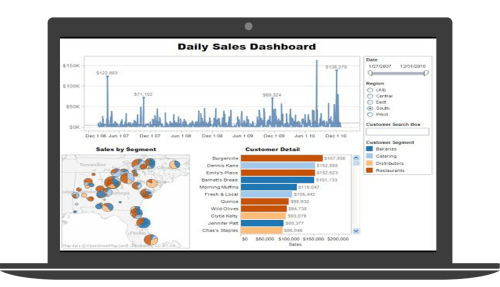
A big favourite among our customers is our Business Intelligence offering. Our Business Intelligence experts are integrating Tableau Software’s BI solution into our customer’s management system in order to provide detailed analyses with customized drillable dashboards, using all real-time data. Our customers are now able to identify hidden trends and strategic information, turn raw data into visual graphs and tables, identify new business opportunities, spot areas of weakness and avoid problems. The insights that our customers are getting from this Business Intelligence solution is giving them the ability to stay ahead of competition.
Contact us to see how our Business Intelligence experts can help you!
The Best Management Software Solutions
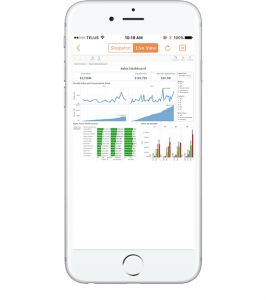 We are certain that demand for these management solutions will only increase, as executives are actively looking to transform their businesses using the latest technologies on the market. We predict that mobile business applications will make this list next year, as business owners are looking to supply their on-site teams with access to their management system to input and review real-time data. Modern, visually appealing, easy to use applications don’t just have to be for personal use; companies should be benefiting from these types of applications as well! One thing is for certain; businesses are looking beyond the brand name when it comes to software systems and taking the time to ensure that the Software Provider and offerings are a good fit for their company.
Contact us today to learn more about how we can help YOU.
I truly believe that there is a right and a wrong IT Service Provider for every business. There could be many right Providers and many wrong Providers. It’s not to say that there’s just one right IT Provider for every one company. The tough part is in determining if an IT Service Provider, or as I like to call them, an IT Partner, is right for YOUR company.
IT is a Value Driver
 In today’s business environment, there’s no denying that IT is a real value driver. We keep finding way too many companies that are still playing “catch up” rather than “getting ahead” of the game, because they are not leveraging technology, as they should be. What business owners don’t realize is that by relying on an IT partner (on the right partner of course!), they can go from just surviving to thriving, due to the benefits they will receive from efficient technologies and helpful IT services. Companies are growing at such a fast rate, industries are evolving and consumer demands are constantly changing. Using technology to solve business and technology-related challenges will provide employees with more time and money to concentrate on what really matters to ensure business growth and success.
Solving Technology & Business-related Challenges with the Right Partner
Therefore, now that we know how important utilizing technology is to a company, it’s time to determine how a business owner can hire the right IT Provider for their company. This Provider should be a good fit for them in every aspect; their software offerings should be flexible, easy-to-use, customizable, within budget and able to integrate with other systems and their support team should be friendly, available, responsive and dependable. On top of this, their IT consultants and developers should be providing expert advice and opinions for the betterment of their customer’s company, NOT to simply make a sale. Many Providers will push customers to buy more systems or services before even solving the customer’s original challenge or issue. At that point, they are adding issue after issue, increasing internal problems for the customer. This is how companies get a real bad taste in their mouth for the IT industry and tend to stick to the wrong IT Provider with the idea that “better the devil you know than the devil you don’t”. It’s unfortunate because not all IT companies out there do this. Namtek Consulting Services opened its doors with the mission to solve business and technology-related challenges of Small & Mid-size companies and to ensure that the IT strategy its team defined for each unique customer supports that customer’s business strategy. The IT services and solutions provided are meant to help businesses find new avenues for growth and to save companies time and money in order to accomplish vital business goals.
So, here are a few things to keep in mind when looking for your next IT Partner;
- Find out how available and dependable their after-sales Support team is (don’t determine this based on the responsiveness of their Sales team). Are they accessible via phone and/or email? Do they respond back to customers within a 24-hour window? Can you build a good relationship with this team, since they’ll be your “go-to” once you’ve implemented your software systems. It’s also important to know if they’ll also be around even if your company doesn’t experience issues; are they continuously trying to find new and better ways of enhancing your software systems and/or streamlining your business processes? As an IT partner, they should always be willing to do what they can to increase business efficiency for their customers. The relationship you build with your IT partner will be extremely important because together (IT experts + your company’s team), you’ll be able to truly solve all of your business and technology-related challenges.
- An IT Partner that has developed solutions that can be integrated with other solutions and can work with other vendors. This helps to create a seamless customer experience. At the end of the day, we want what’s best for the customer. It’s tough when we keep seeing other Software Providers refuse to provide access to their customer’s database so they can integrate their system with another solution (like an eCommerce Store). This causes a lot of headaches for the customer and just makes their job that much harder.
- The IT Partner has the ability to carefully listen to a customer’s challenges, assess their needs and then identify the desired experience for that customer. Every business is different; there may be similar processes and products sold, but every owner has different views for their business or has different expectations. We encounter all sorts of people from companies and each and every one of them has a different view of software solutions and different wants and needs. Therefore, if your IT Partner can identify the right experience that will fit well with your business, they’re a keeper!
- The software solutions provided are flexible, scalable, user-friendly and affordable, as I mentioned earlier.
- You can get a real sense that the IT team is honest, reliable and transparent in all of their dealings with you.
- You feel like a real partner rather than just a sale to the IT Provider.
As a side note:
Unsuccessful and painful software implementations can still arise even if you have chose the right IT Partner for your business. How does this happen? As I have mentioned in many previous articles, a software implementation is a joint effort; between the IT Provider and the Customer. Having the right leadership within a business to bring a positive mindset out of the employees (or users of the new system) will allow these employees to accept the new system, accept all the changes that will be coming with this new system and move forward peacefully. Otherwise, employees will resist and refuse to help bring this implementation to a successful end. Common complaints that may be heard are “this system doesn’t work”, “I’m not used to doing it this way”, “I liked the old system better”… Any change is difficult but with the right encouragement and proper training, it can be done successfully.
Therefore, before you decide that you will stick with your current IT Provider, even though you know they aren’t a good fit for your company, contact us to see if our partnership will be right for you. You have nothing to lose and everything to gain!

Latest Blog Posts
 ERP vs. Business Operations Platform: What’s the Difference for SMBs?September 21, 2026 - 6:32 pm
 Beyond Spreadsheets: What Is a Business Operations Platform?September 14, 2026 - 5:25 pm
 7 Warning Signs Your Business Has Outgrown Its SoftwareAugust 25, 2026 - 8:07 pm