Why companies choose to integrate EDI into their webshop
We like online stores and we like EDI services. By integrating the two, we’ll cherish them both even more.
In most of our blogs, we discuss the benefits of integrating and automating business processes through the use of modern, efficient management systems. With all our customers, we’ve found that the right IT solution can not only affect business growth and productivity, but also affect employee mood and stress levels.
When processes run smoothly, employees are happier and less stressed. They are able to work in a positive environment and can spend their time on important tasks that will contribute to the company’s growth, rather than spending their day entering data into the management system and feeling frustrated and demotivated.
Set up an e-commerce store
So, when we meet business owners who have recently set up an e-commerce store in their company, like the one at Shopify, we explain the possibilities and advantages of integrating this store not only with their ERP management system, if they have one, but also with EDI capabilities.
Many companies may be using all three technologies. They can have a management system that handles their accounting, sales, inventory and purchasing, and also use EDI services to send and receive purchase orders and invoices with their business partners.
EDI to automate processes
What many executives tend to forget is to integrate all these technologies together to further streamline and automate processes, reduce manual data entry and improve efficiency. Why hire more employees to enter new orders from your partners via EDI into your ERP system if you can automatically transfer all orders directly to the system? Why not take advantage of the ability to send orders from your e-commerce platform directly to your suppliers or manufacturers via EDI?
Enhancing the capabilities of a company’s e-commerce platform with EDI capabilities will undoubtedly ensure a better balance between customer demands from the online store and supply chain requirements.
The aim is to exchange real-time information with suppliers quickly and automatically, to ensure that the supply chain is managed as efficiently as possible.
EDI for faster order processing
The aim is to ensure that orders are processed and dispatched quickly to meet consumer needs. This is to offer consumers greater visibility of specific product inventory levels. The aim is to improve communication between distributors, retailers, manufacturers and customers. At the end of the day, what company doesn’t want to increase the speed of order processing and invoice payment receipt, as well as improve overall efficiency to boost sales?
E-commerce stores, EDI services, and modern, easy-to-use ERP systems are all on the rise. Many business owners are increasingly interested in the latest business technologies that have the potential to help their company grow and succeed. We invite everyone to integrate all these systems to see great improvements!
Read more of our blogs on e-commerce and EDI integration by visiting our EDI2XML blog page.
This post was updated to reflect current trends and information
In the current modern times, the success of any business (small, medium or large) is directly related to the capabilities of its IT infrastructure.
The need for information technology is always growing within any business. This need often overloads the physical IT infrastructure of any company, and the IT team becomes very stretched. Using Private Cloud Hosting provider, instead of on-premises physical infrastructure, gives a business several significant advantages. Following are some of the major advantages:
1 – Private Cloud: Reduced starting costs
The costs of the purchase of equipment, its installation and continuous support not only greatly affect the budget of any enterprise, but often becomes a showstopper in the development of IT infrastructure, and therefore the development of the whole company. Outsourcing to a private cloud hosting provider, companies will have the ability to host their software solutions in the Cloud, saving them on expensive hardware costs, and most important, the recurring management and continuous upgrade, support and starting cost.
2 – Increase in flexibility and speed of implementation of IT solutions
Adopting a Private Cloud and Managed Cloud Service provider, companies can quickly adapt their IT infrastructure to their current needs to fit their own business.
This will add flexibility and efficiency to a company’s IT solutions, and save a lot of money, since it will no longer need to reserve unnecessary equipment and human resources not needed.
The flexibility of a Private Cloud will allow a company to rapidly adjust it to its more important projects, and not abandon them, because of the cost of purchase of new equipment or the labor cost for implementation, add to it the long-term maintenance. Accelerating the implementation of new IT solutions increases the efficiency of any business.
3 – Purchase and support of equipment – this is no more a company’s headache
Using a private cloud infrastructure, a company will save a tremendous amount on hiring the highly qualified and expensive employees who were previously engaged in the purchase of equipment, its continuous support, and ensuring network accessibility. Now companies will be able to concentrate on more important strategic tasks.
By delegating responsibility for the operability of IT equipment to a Managed Cloud Provider, companies get the opportunity to concentrate on their core business and increase their effectiveness.
Managed Cloud Provider
Namtek Consulting Services is the right choice if a company is looking for reliability, security, competitiveness and a personalized approach. Our long-term proven expertise in the market of IT systems and infrastructure, allows us to implement almost any cloud infrastructure project. Our platform is a virtualized platform running on sophisticated SANs and hypervisors. We use brand new state-of-the-art equipment and hardware and host it in a couple of Tier II secured data centers in Montreal (Canada).
Want to try launching your first cloud project? Contact us and our technical consultants will assist you in recommending the best cost-effective options for your business.
Business Continuity: How to Avoid Downtime and Data Loss
How can businesses restore their backup data without incurring downtime and loss? Let’s quickly go over a brief description of a Business Continuity.
What is Business Continuity?
A Business Continuity solution is the combination of the latest backup technology and advanced processes to will ensure the business continues as usual in case a disaster strikes. It comprises of a BDR hardware device, could be a really small depending on what’s needed. It can extract and backup complete computer systems, both on a virtual and a physical machine, and can store it on both on the equipment itself and in cloud storage.
The company will benefit from double security. If something happened to the real hardware device, the data could be quickly restored from the cloud.
The goal of business continuity is to reduce downtime and reduce recovery time so that business processes do not interrupt or stop.
The top causes of downtime
Let’s look at some common causes of downtime and the costs associated with this business interruption:
- Human error – accidental deletion/change to data continues to be a key driver for data loss, impacting productivity specially if workers must spend time repeating previous work.
- Ransomware attacks, malware, data corruption – data can be lost or damaged due to malicious cyber-attacks, or through hardware/software faults.
- Hardware failure – despite improving hardware reliability, laptops still last on average just 3 years, making data loss due to sudden hardware failure a reality.
- Hardware theft or loss – as the workforce becomes more mobile, it is more likely devices such as laptops are lost or stolen.
- Environmental events – we hear more and more about natural disasters and the impact they have on businesses. Whether it is fire, water damage, or a tornado, you need to put safeguards in place to protect clients’ business data.
It’s important to put your business’ security first, even if you think the chances of a disaster striking your company are unlikely, you never know what can happen. Eliminate data loss and downtime costs with a Business Continuity solution like QBR and get that peace of mind you always wanted.
Having a simple, secure, automated way to protect and recover business data can reduce the risk of data loss.
How to choose a Business Continuity Solution
Finding the right Business Continuity solution for your company isn’t always easy. However, if done correctly, your critical company data will be secure 24/7 and easily restorable in case of a disaster. Even if unexpected disasters, such as fires, floods, or simply equipment failures, are unlikely, your business should always be prepared for them.
Here are 5 key points to look for when selecting a Business Continuity solution:
1. It should backup and restore files easily, with a simple and quick implementation process and a flexible upgrade policy.
2. The solution should provide multiple recovery points, in order to go back in time and have the option to restore from any given backup. On top of this, these recovery points should be compressed and stored on its own hardware storage device.
3. It should be able to export the backups as HyperV or Vmware files for deployment on any virtual environment.
4. It should offer a quick and efficient “bare metal” restore; which is the process of restoring a complete “virtual machine” sitting on the local device into a physical machine.
5. It should be a hybrid solution, that is based on virtualization, both on the local device and in the “cloud” (hybrid solution); this entails a backup done of a whole physical or virtual machine into one file and sent to the “cloud” after compression and encryption.
When selecting your Business Continuity solution, it’s also important to look at the specifications of the technology as well as the vendor. When you find a business continuity solution that has all of these key points and specifications, like the QBR solution, your business will be able to meet or exceed your Recovery Time Objective (RTO).
Do not risk your business! Choose the safest and right insurance to back up and restore your data with QBR.
Contact us today!
“If you think education is expensive — try ignorance”. — Derek Bok, president of Harvard University.
User training is one of the puzzle’s pieces which allows you to create a complete picture of a successful implementation project. Attention should be paid to end-user training in the case of implementing such IT systems as ECM (Enterprise Content Management), which will be used by many employees.
 No less important is the training of ERP and CRM users, because they are aimed at solving complex business problems. Whether an implemented IT system or business application becomes a productive and useful tool for a company, directly depends on the well-organized training for end users.
In this article, we will look at end-user training in terms of process organization.
We will examine a different kind of ways to organize end-user training on implementation projects, limitations, advantages, and disadvantages of each approach, as well as our experience in applying some of these methods on IT implementation projects.
These days, the most popular methods of organizing end-user training are:
- small group training in a computer lab;
- face-to-face workshops;
- webinar seminars;
- training videos integrated into the system;
- e-Learning.
Let’s review each method for various parameters: the number of users, the effectiveness of training, training schedule, complexity and cost.
Small groups user training in the computer class
 This training method is optimal for organizations where the number of users working constantly with the new system is limited to several tens. The method is most effective in terms of the quality of education. Computer room user training is also recommended if the majority of employees do not have practical experience in using the automation systems. In this case, it is recommended to conduct full-time training with practical exercises. Based on our experience, such a format is most often used to educate a workgroup first.
Advantages |
Disadvantages |
| · Possibility to present material in greater volume or with more detail
· A more guaranteed result from training · Animated dialogue with the teacher, possibility to ask questions · Opportunity to get practical skills |
· A limited number of users at once
· The high cost of training per participant · The duration of training due to the combination of theory and practice
|
Full-time seminars for users
 This method is optimal for organizations with 100-200 users (it could be in case of ECM implementation). This training method is less effective than the previous one, but at the same time, it retains the ability to ask questions and get answers to them in real time. It is recommended to make a video recording of the training seminar, so in the future, end-users can refer to it and refresh their knowledge.
From our personal experience of using face-to-face seminars, we can recommend combining such training with detailed user instructions (both for the business process and for distribution by roles). It is also necessary to provide resources for the organization of the first line of user support at the stage of pilot production.
Advantages |
Disadvantages |
| · Ability to reach a significant number of users
· Low cost of training per user · Short term training · The possibility of dialogue with the teacher, the opportunity to ask questions, clarify |
· The material is presented in theoretical form, there is no possibility of practical use of the system (it is impossible to “touch” during the training session)
· Training material is limited, most often gives a general idea of the work in the system. |
Webinar user-training workshops
 Webinar end-users training is optimal for companies where the number of users is several hundred and more and/or employees are geographically detached.
From our experience of conducting webinars, I would like to draw attention to the following points: webinars are devoid of “eye contact,” the teacher is hard to get feedback from the audience in real time. However, if users are employees who already have experience in automation systems, such a format is quite viable.
Advantages |
Disadvantages |
| · Capacity to reach a significant number of users
· The ability to train users without leaving the workplace (for example, employees of company branches in different cities) · Low cost of training per user |
· The material is presented in theoretical form, there is no possibility to practice during the webinar
· Training is limited, often gives general information of the work in the system. · The risk of technical problems |
Training videos embedded in the IT system
 This method also has no restrictions on the number of end-user and the time of training. Training videos demonstrate the standard functionality of the system, without taking into account any additional modifications for a specific customer. Therefore, it can be recommended to those companies whose business processes fit into the standard functionality of the system or have been adapted to the system.
Watching videos does not replace full-training and is recommended as an addition to other formats of user training.
Advantages |
Disadvantages |
| · No need to specifically organize end-user training. Any user can refer to the training material at any time.
· No additional financial investments |
· Videos provide the ability to view a demonstration of the functional, but there is no way to perform any practical tasks. (Is not recommended to train in the “live” system)
· They describe the standard functionality, do not take into account the customizing system for a specific customer. |
Online Learning Tools (e-Learning)
 The use of online learning tools (for example, based on SAP Enable Now, Oracle Learning, DoceboLMS, etc.) is recommended for large organizations with a large number of users working in the system, including employees who working from home-office. Users can independently allocate time to complete these courses, and then refer to them if necessary when performing their daily duties.
In terms of efficiency, the method is comparable to training in a computer class, because a user can test his knowledge’s in a practical task.
Advantages |
Disadvantages |
| · No need to specifically organize training, users at any time can refer to the training material.
· No need a large number of employees to provide first-line user support · The opportunity to get theoretical knowledge and still see a demonstration of certain actions in the system and reproduce them in a practical unit. |
· The high cost of distance learning tools.
· There is no possibility for live-dialogue with the teacher, for asking questions
|
If you want to learn more about user training, please read other materials:
- User Training: The Key to Unlocking the Benefits of a Software System
- The importance of User Training during software implementation
- How A Proper End User Training Can Improve Performance After A New Software Implementation
- Why software upgrades in companies can cause panic and fear
We, as a Software Provider, truly understand how important it is to organize user training for employees. It is necessary to pay attention to users’ needs, and not only to the system being implemented. Investment in employee training will allow enterprises to quickly get the benefits that the new IT system provides.
When software experts mention the words “business disaster” or “disaster recovery”, many top business people think about natural, or weather, events, such as floods, hurricanes, fires, ice storms, earthquakes, tsunamis, wind storms, etc. These disasters can of course occur at a company and can have devastating repercussions, such as prolonged downtime, property damage, injuries and more. The likelihood, however, of such weather events are much less likely than technological and man-made events.
Technological and man-made disasters, including hardware failures, software malfunctions, user errors, security breaches, etc., can also have devastating effects on a business’ operations, causing downtime, data loss, lost productivity, lost revenue, delayed sales, increased expenses and more. One hour of downtime can cost companies anywhere between tens of thousands of dollars for small businesses to hundreds of thousands of dollars for large organizations!
It’s critical to know your Recovery Time Objective (RTO), which is your company’s maximum allowable downtime. How long can you go down and survive? If your RTO is seconds or minutes, then you better make sure you have a business continuity solution with off-site data storage.
 Many businesses, without a proper business continuity and disaster recovery plan and solution, don’t recover from some disasters. So, before you think to yourself, “well we have beautiful weather here or we hardly ever get power outages, why should I pay for a Business Continuity Service?” – remember that your company is much more likely of falling victim to a ransomware attack, having an employee accidentally delete an important file or dealing with a malfunctioning server. No matter what sudden disastrous event occurs, you want to be protected. Ask yourself, is my company’s data worth risking? You may have gone the last 10 years disaster-free but can you truly guarantee that the next 10 years will also be free of crisis?
Business Continuity services for complete data protection
In our blog Business Continuity: A Much-Needed Insurance Policy For Your Data we mentioned the term “data insurance”. This is how our customers view their Business Continuity solution and service. They see it as an insurance policy in place to protect their company’s most important asset – their data! Companies are more and more willing to pay a monthly Business Continuity service fee to ensure that their data is 100% protected as well as easily and quickly recoverable. It’s useless to simply backup your data only to realize after a disaster struck that it takes DAYS to recover it all! Now that companies are using full management systems rather than keeping important information on paper, they realize the need for such a backup solution.
Don’t be Victim of Ransomware
 We all keep hearing about Ransomware. This type of security breach is currently a big problem for businesses, even individuals, all over the world. The likelihood of a company experiencing a ransomware attack is very high. This virus not only encrypts a company’s data but also demands payment for it to be unlocked. The governments discouraged victims from paying hackers since paying the ransom does not guarantee the release of their files.
There are many ways a company can fall victim to such a cyber attack. The most common are when computer users click on a bad link or download an encrypted email attachment. Other scams include phishing, baiting, quid pro quo, pretexting and tailgating.
Be prepared for any business disaster with Business Continuity
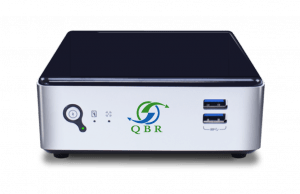 QBR (Quick Backup Recovery) is a hybrid business continuity and recovery solution. It has the capability to store data both on premises and in the cloud. No human intervention is needed during backup. Virtual Machine snapshots are scheduled from the start at which point QBR can take snapshots at intermittent times throughout the day of the office servers and workstations to be stored on the QBR device as well as pushed off-site in the cloud. This off-site capability ensures optimal safety in case the QBR device gets damaged from a fire, flood, or other means on-site. During the restoration process, there are several options available to the business;
- File Restore: If the company needs to recover a specific file(s) from a specific VM taken at a specific time of the day
- Bare Metal Restore: If a company needs to restore a complete VM from the local device into a physical machine
- Export VM: If a company needs to restore the backup from the QBR device to HyperV or VMware format, so it can be deployed on a virtual environment.
With all of these options, a company’s data can be accessed almost immediately during a disaster. The whole point of a Business Continuity solution is to ensure a business remains operational, without any data loss, during a disaster.
Keep your business data safe from hackers and other disasters
It’s important to understand why total data protection is essential in today’s business world. Businesses are now run and managed with software systems so it’s important to ensure no downtime is incurred if something unexpected happens. Companies must not only protect themselves from natural disasters but also from technological and man-made events, which are much more likely of occurring. Reduce your risks with a Business Continuity solution and a solid disaster recovery plan.
When it comes to your business’ future, don’t take a chance! Look into the safest way to backup and restore your data with QBR.

Latest Blog Posts
 Shadow AI: The Hidden Risk Inside OrganizationsFebruary 25, 2026 - 9:46 pm
 EDI Services in Canada: A Local Expert with 25+ Years of Integration ExperienceJanuary 30, 2026 - 8:53 pm
 How to Protect Your Business with Three Essential Levels of CybersecurityNovember 7, 2025 - 8:13 pm