ERP vs. Business Operations Platform: Understanding the Difference
For a small or mid-sized business, choosing a business management system is not simply a question of finding the software with the most features. The right choice depends on what the business needs to manage, how complex its operations are, which systems it already uses, and how much infrastructure it needs to support.
An ERP (Enterprise Resource Planning) system is designed to connect a broad range of business functions, often including finance, procurement, inventory, sales, supply chain, manufacturing, human resources, and reporting. A Business Operations Platform typically has a more focused scope, concentrating on the operational processes a business needs to manage day to day.
Both approaches can be appropriate for an SMB. The difference is in the scope of the system and the business requirements it is intended to address.
What Is an ERP?
ERP stands for Enterprise Resource Planning. An ERP system brings multiple business functions into a connected environment so that information can be shared across departments and processes.
Depending on the product and industry, an ERP may include:
- Accounting and financial management
- Purchasing and procurement
- Inventory management
- Sales and order management
- Supply chain management
- Manufacturing
- Human resources
- Project management
- Reporting and analytics
Modern ERP systems can also connect with other applications through APIs, pre-built connectors, and integration platforms. The exact capabilities vary significantly between ERP products and editions.
For an SMB with complex financial, operational, manufacturing, or supply chain requirements, an ERP can provide the broad business management environment it needs.
What Is a Business Operations Platform?
A Business Operations Platform focuses on the processes a business uses to manage its everyday operations.
Rather than trying to cover every business function, a platform can focus on a defined set of operational needs such as:
- Product management
- Inventory
- Sales orders
- Business data
- EDI
- Demand forecasting
- Operational workflows
This approach can be relevant to SMBs that need a structured system for managing their operations but do not necessarily require the full scope of an ERP.
The distinction is not that one type of system is suitable for large companies and the other is only for small companies. It is about scope and fit.
ERP vs. Business Operations Platform: What Is the Difference?
The main difference is the breadth of the system.
| ERP | Business Operations Platform | |
| Primary focus | Broad business management | Core operational processes |
| Typical scope | Finance, procurement, inventory, sales, supply chain, manufacturing and other functions | Products, inventory, orders, EDI and other selected operations |
| Business requirements | Often suited to businesses with broad or complex processes | Suited to businesses with more focused operational requirements |
| Implementation | Can involve multiple departments, workflows, integrations and data migration | Can be more focused on specific operational processes |
| Approach | Comprehensive business management system | Modular operational environment |
| EDI | May be available natively or through connectors, modules or external integrations, depending on the ERP | Can be included as part of the platform, depending on the product |
This comparison is intentionally general. ERP products differ considerably, and some ERP systems are highly modular and designed specifically for SMBs. Likewise, Business Operations Platforms can differ in the processes they cover.
Does an SMB Need an ERP?
Not necessarily.
An SMB may benefit from an ERP when it needs to manage a broad range of interconnected business functions from one system. For example, a company with complex accounting, purchasing, manufacturing, inventory, supply chain, and reporting requirements may need the broader capabilities of an ERP.
An ERP can also make sense when a business wants to standardize processes across multiple departments or locations.
However, a business should first identify the operational problems it actually needs to solve.
If the main challenges involve managing products, inventory, sales orders, EDI transactions, and demand planning, a full ERP may provide capabilities that are outside the company’s immediate requirements.
The question is not whether an ERP can manage these processes. It can. The question is whether the business needs the broader ERP environment to manage them.

When Does a Business Operations Platform Make Sense?
A Business Operations Platform may be appropriate when a company needs to move beyond spreadsheets, manual processes, and disconnected operational tools but does not require a full ERP system.
For example, an SMB may need a centralized way to:
- Maintain product information
- Track inventory
- Manage sales orders
- Process EDI transactions
- Connect operational information
- Plan future demand
- Reduce repetitive manual data entry
In this situation, a focused operational platform can address the company’s immediate requirements while providing a structured foundation for future growth.
This can be particularly relevant for businesses that have grown beyond spreadsheets but are not ready for, or do not require, a broad ERP implementation.
What About EDI?
EDI is an important consideration for businesses that exchange electronic documents with retailers, distributors, manufacturers, logistics providers, or other trading partners.
An ERP does not automatically mean that EDI is included in the same system. Depending on the ERP and the business requirements, EDI may be provided through a native module, a third-party connector, an EDI provider, or another integration approach.
ERP integration is often used to connect an ERP system with external applications and services, including EDI platforms. In an integrated setup, orders, invoices, shipping information, inventory data, and other business information can move between the internal system and the EDI environment.
This can work well, but it also means that EDI may become a separate part of the technology environment that needs to be configured, maintained, and connected to the company’s internal processes.
POINT Includes EDI as Part of the Platform
For businesses that rely on EDI, this is an important distinction when evaluating a Business Operations Platform.
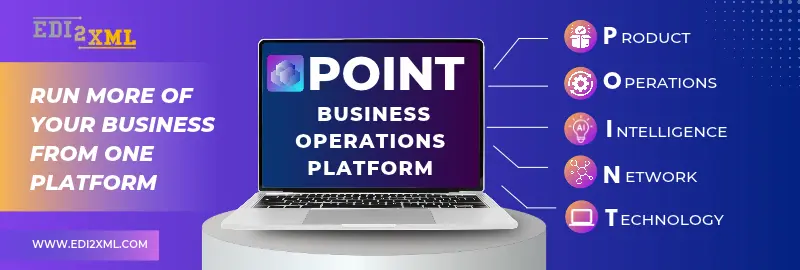
POINT is a Business Operations Platform developed by Namtek and EDI2XML for small and mid-sized businesses. Its modules include:
- EDI (Electronic Data Interchange)
- Product Management
- Inventory Management
- Sales Management
- AI-powered Demand Forecasting
EDI is therefore part of the POINT environment rather than being treated only as an external service that needs to be connected to the business operations platform.
This approach can be useful for SMBs whose daily operations already depend on EDI. Instead of managing product, inventory, sales order, and EDI processes as completely separate activities, these functions can be managed within the same operational environment.
That does not mean POINT replaces every system a business may use. A company may still use separate accounting, CRM, ecommerce, or other specialized applications. The difference is that EDI is already part of the platform’s operational scope.
ERP or Business Operations Platform: What Should an SMB Consider?
There is no universal answer. An SMB should start with its current business requirements rather than choosing a system based only on the number of features it offers.
An ERP may be a better fit when:
- The business needs comprehensive financial management.
- Multiple departments need to work within one broad business system.
- Manufacturing or complex supply chain processes are important.
- The company operates across multiple locations or business units.
- Extensive reporting, planning, procurement, or other enterprise functions are required.
- The business is prepared for a broader system implementation.
A Business Operations Platform may be a better fit when:
- The primary need is managing day-to-day operations.
- Products, inventory, sales orders, and EDI are core requirements.
- The company is moving beyond spreadsheets and manual processes.
- The business does not need the full scope of an ERP.
- A more focused and modular approach is preferred.
- The company wants to address specific operational gaps without replacing every business system it already uses.
ERP vs. Business Operations Platform: Which One Is Right for Your Business?
The answer depends on what your business actually needs to manage.
An ERP can provide a comprehensive environment for businesses with broad and complex requirements. A Business Operations Platform can provide a more focused approach for companies that need better control over their core operational processes.
For an SMB evaluating its options, useful questions include:
- Which business processes need to be managed in one system?
- Which processes are currently handled through spreadsheets or manual work?
- Does the business need financial, HR, manufacturing, or supply chain functions within the same platform?
- Is EDI a core part of daily operations?
- Which existing systems need to remain in place?
- Does the business need a broad ERP or a more focused operational system?
- How much implementation and customization does the business actually require?
The goal is to choose a system that matches the business’s current operational requirements while leaving room for future needs.
For some SMBs, that may mean implementing an ERP. For others, a Business Operations Platform may provide the functions they need without introducing a broader system than their operations require.
Frequently Asked Questions
Is a Business Operations Platform the same as an ERP?
No. An ERP is generally designed to manage a broad range of business functions, while a Business Operations Platform typically focuses on selected operational processes. The exact scope depends on the platform.
Is an ERP better than a Business Operations Platform?
Neither is universally better. The appropriate choice depends on the company’s processes, size, operational complexity, existing systems, and functional requirements.
Can a small business use an ERP?
Yes. Many ERP products are specifically designed for small and mid-sized businesses. The important consideration is whether the ERP’s scope and implementation requirements match the company’s needs.
Does ERP software include EDI?
Not necessarily. Some ERP products offer EDI capabilities or integrations, while others rely on third-party EDI providers, connectors, or integration platforms. EDI requirements should therefore be evaluated as part of the overall system architecture.
Does POINT include EDI?
Yes. EDI is one of the modules within POINT, alongside Product Management, Inventory Management, Sales Management, and AI-powered Demand Forecasting.
Can a Business Operations Platform work with other business systems?
Yes. A Business Operations Platform does not necessarily need to replace every system a business already uses. Depending on the platform, it can work alongside accounting, CRM, ecommerce, or other specialized applications through integrations.
Is POINT an ERP?
No. POINT is positioned as a Business Operations Platform for small and mid-sized businesses. It focuses on core operational processes including products, inventory, sales orders, EDI, and demand forecasting rather than positioning itself as a full ERP system.