In today’s business world, the right technology can make a world of difference. IT experts are always pushing to install the best hardware, software, IT services and cloud applications to simplify the lives of business people. This year has been another big year for IT advancements and we couldn’t be more excited about that. We love seeing businesses leverage technology with the right solutions for them, in order to benefit from efficiencies and cost savings.
Here are our most popular and most requested management software solutions and services.
EDI2XML Translation Service
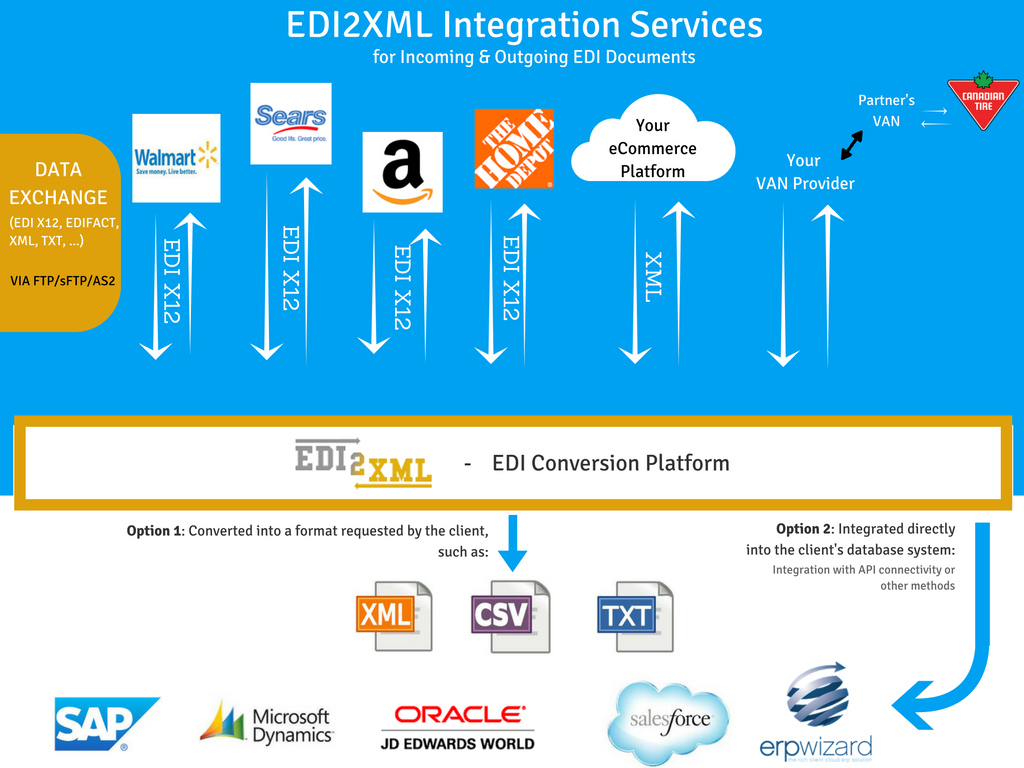
Year after year, we keep seeing an increase in demand for EDI (Electronic Data Interchange) services. Business executives don’t want to hire a full-time in-house EDI specialist anymore to handle their EDI transactions. Nor do they want to hire more customer service reps to manually enter all incoming purchase orders anymore. Many retailers and suppliers are now requiring that any company they do business with must send and receive documents, like Purchase Orders Invoices and Advance Shipping Notices, via EDI.
Companies today are looking not only to implement EDI but to automate this entire process with an outsourced EDI provider. This is why our EDI2XML Translation Service has been one of our most popular services this year. We handle our customers’ EDI requirements from A to Z; we convert their incoming EDI documents into their preferred file format, such as XML (and convert their outgoing XML documents into EDI), as well as handle all new Partner and document setups and manage their continuous communication with their Trading Partners. Our service is affordable, our setup phase is quick and our EDI support team is easily accessible and available; making it the perfect EDI service for any business.
Try it for yourself today!
QBR Business Continuity
With ransomware cyberattacks increasing worldwide, it’s not unusual for business executives to come running, asking about our QBR solution. Using the latest technology on the market, this Business Continuity & Disaster Recovery solution is THE best way to protect your data from hardware/software failures, human error, natural disasters, ransomware, computer viruses and more.
No matter the disaster, QBR allows you to recover your data quickly and easily. Businesses can no longer afford to incur downtime that lasts days or weeks, only to later realize that their old, dusty backup tapes haven’t been working for months! With on-site and off-site virtualization, ransomware detection, advanced screenshot verification emails, infinite cloud retention, unlimited agent licensing, instant recovery of entire servers/workstations and more, a company’s data is well protected!

Learn more about QBR here.
Management Software Solutions – The ErpWizard Suite
We are definitely still seeing a demand for complete Enterprise Resource Planning (ERP) systems in the business world. The demand comes from companies that either don’t currently use IT systems to manage their business operations, but instead still use Microsoft Office tools like Excel and Word, as well as companies looking to update their outdated, complex, expensive ERP software.
The transition to a simple, modern ERP system, like our homegrown system – The ErpWizard Suite, has allowed companies to increase visibility into their operations, improve data quality, reduce manual data entry, improve customer service and increase productivity. At the end of the day, when a company has found the right ERP system and Software Provider for their business, they can automate and streamline their processes and improve business agility and performance. That’s the goal of any ERP system. Unfortunately, not many companies realize these benefits at the end of their software implementation (you’d be surprised how many companies don’t even successfully make it to the end of their implementation!).
Technology in the workplace is meant to make business people’s lives a whole lot easier, which is why executives are realizing the importance of a helpful, available, and accessible support team, a flexible, easy-to-use system, and affordable IT costs.
ERP system qualities
Here are some of the main qualities of an ERP system that business executives are looking for:
- Flexibility
- Can easily integrate with other systems
- Is effortlessly accessible from anywhere, at any time to allow users to stay in touch with business operations, even while on vacation or on a business trip
- Easy to use, with a simple, modern interface
- Is continuously updated to accommodate to the ever-changing business environment
- Is well supported by an available and accessible IT support team
- Is affordable !!
This year we have been especially excited about our newly improved ErpWizard Suite. Now, with its new modern, sleek interface, end users will actually enjoy using an ERP system. It’s about time companies moved away from those complex, boring looking, out-dated systems and towards simple, visually appealing management applications, that won’t break the bank.
What do you think of ErpWizard’s new look?
WIMS 2.0 – Warehouse Management
Warehouse Management is another popular software solution, usually integrated within a company’s ERP system. This system allows for better visibility and control of all warehouse activity, which is an absolute must today. A Warehouse Management system allows businesses to know;
-
What’s been delivered and when
-
Where all items are stored in the warehouse facility
-
Which items to pick and how much to pick for delivery
-
The right items to pack using the right shipping cartons and materials
-
What items to ship and where to ship them
All of this is exceptionally important in order to reduce operating expenditures, increase data accuracy, shorten fulfillment lead times, move inventory faster and increase data accessibility. By using wireless scanners, this inventory data collection system is truly bringing better control and insight into warehouse processes. If a company’s warehouse is in order, customers are better served and happy!
Business Intelligence & Analytics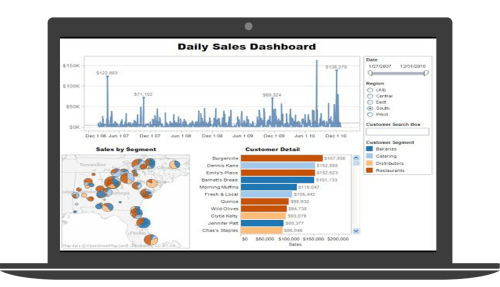
A big favourite among our customers is our Business Intelligence offering. Our Business Intelligence experts are integrating Tableau Software’s BI solution into our customer’s management system in order to provide detailed analyses with customized drillable dashboards, using all real-time data. Our customers are now able to identify hidden trends and strategic information, turn raw data into visual graphs and tables, identify new business opportunities, spot areas of weakness and avoid problems. The insights that our customers are getting from this Business Intelligence solution is giving them the ability to stay ahead of competition.
Contact us to see how our Business Intelligence experts can help you!
The Best Management Software Solutions
 We are certain that demand for these management solutions will only increase, as executives are actively looking to transform their businesses using the latest technologies on the market. We predict that mobile business applications will make this list next year, as business owners are looking to supply their on-site teams with access to their management system to input and review real-time data. Modern, visually appealing, easy to use applications don’t just have to be for personal use; companies should be benefiting from these types of applications as well! One thing is for certain; businesses are looking beyond the brand name when it comes to software systems and taking the time to ensure that the Software Provider and offerings are a good fit for their company.
Contact us today to learn more about how we can help YOU.
 It’s not uncommon to find large and small companies either using multiple separate systems or using Excel Spreadsheets and emails to run the business. Most likely, what you’ll find at these companies are employees relying heavily on their emails to track and manage important files and information, miscommunication between departments, inaccurate and outdated data being shared, and more inefficiencies.
 For many business owners or managers, making the decision to implement a new software system is a difficult one to make. Oftentimes, the changes and risks that come with a software implementation can discourage those business managers who are looking to streamline their company’s processes and improve overall efficiency with a new system. There’s a ton of information out there on the advantages of using an efficient, up-to-date
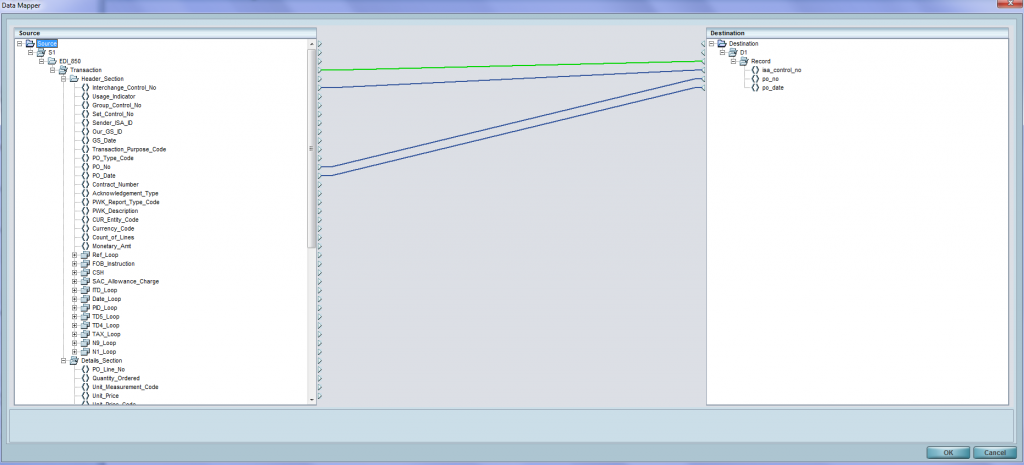
 System integration is the process of bringing multiple systems or applications into one, allowing them to work together. The goal is so that every system that is being used at the company, be it your CRM, Enterprise Resource Planning (ERP), Warehouse Management, B2C eStore, EDI, etc., will be using a single database. This reduces the need to constantly update different systems and resort to many hours of manual data entry. In today’s fast-paced business environment, it’s crucial that companies have management applications that can speak with one another and share information between them. This results in better visibility and accessibility of information, faster decision-making, reduced redundancies, increased efficiency and more.
 Do you have your own eCommerce Store, perhaps built with Shopify, or sell your goods online through Amazon, Cabela’s, eBay, etc.? If so, we are quite certain you’ve already been in discussion about how to best exchange data between you and your Trading Partner(s) or between your eCommerce platform and your internal software management system (i.e. your ERP system, CRM (Salesforce)…). In some cases, you may not have much of a choice, as some Trading Partners send their communication requirements prior to beginning a business relationship. For example, partners like Cabela’s or Amazon often push suppliers to be EDI compliant. At that point, it’s time to get in contact with an EDI provider to learn more about this process for your specific business needs.
 We’ve all heard our fair share of nightmare stories when it comes to new software, more specifically Enterprise Resource Planning (ERP), implementations. What we don’t often hear, however, are the mistakes that were made during this project that could have been avoided. In many of these stories, the blame is put on the Software Provider or on employees who resist change and the system. However, there are some mistakes that business executives make that can affect the outcome of an ERP software implementation.
 It’s already nearing the end of 2016. Crazy how fast time flies! For many people, this time is the busiest, filled with corporate events, family gatherings, holiday shopping, vacations and more. For many businesses, especially in the retail industry, it’s also one of their busiest times of the year. However, there are those industries or companies where December is a quiet month, making it the perfect time to look ahead and plan for the upcoming year. It’s when executives can finally set aside a few hours or days to establish and finalize next year’s budgets, prioritize upcoming projects, assess employee performance and review goals and benchmarks for the following year. What our consultants always encourage is to also set some time aside to review business processes and determine which ones aren’t working well anymore. For example, are you noticing an increase in unhappy customers, an increase in manual data entry, duplicated work, an increase in costs, missed deadlines, frustrated, and unproductive employees…? If so, it’s definitely time to improve the processes that don’t work and are leading to these problems.
 In today’s business environment, there’s no denying that IT is a real value driver. We keep finding way too many companies that are still playing “catch up” rather than “getting ahead” of the game, because they are not leveraging technology, as they should be. What business owners don’t realize is that by relying on an IT partner (on the right partner of course!), they can go from just surviving to thriving, due to the benefits they will receive from efficient technologies and helpful IT services. Companies are growing at such a fast rate, industries are evolving and consumer demands are constantly changing. Using technology to solve business and technology-related challenges will provide employees with more time and money to concentrate on what really matters to ensure business growth and success.
 It’s no secret that our EDI2XML team enjoys helping companies increase efficiency, improve partner relationships, speed the flow of goods to customers and improve shipping accuracy by enabling them to easily exchange documents electronically between trading partners.


